

Why Level P-5 Shredding Matters for Data Security
Improper document disposal is a major risk. Sensitive information tossed in recycling bins can lead to identity theft, data breaches, and fines under Canadian privacy laws like PIPEDA, which can reach up to $100,000 per violation. Basic shredders aren’t enough - strip-cut and cross-cut shredders leave documents vulnerable to reconstruction.
Level P-5 shredding offers a secure solution by turning documents into tiny, confetti-like particles that are nearly impossible to piece back together. It’s ideal for destroying confidential data like Social Insurance Numbers, medical records, and financial documents. This method not only protects sensitive information but also ensures compliance with Canadian privacy regulations.
Here’s why P-5 shredding is critical:
- Security: Reduces documents into over 2,000 particles per A4 sheet, making reconstruction nearly impossible.
- Compliance: Meets Canadian privacy standards, including PIPEDA and PHIPA, and provides legal proof of destruction.
- Cost-Effective: Balances high security with reasonable energy use compared to higher shredding levels.
With data breaches in Canada costing an average of $4.66 million in 2024, businesses and individuals can’t afford to ignore secure disposal practices. Whether it’s paper or electronic media, professional shredding services like Nerds Need ensure secure handling, compliance, and peace of mind.
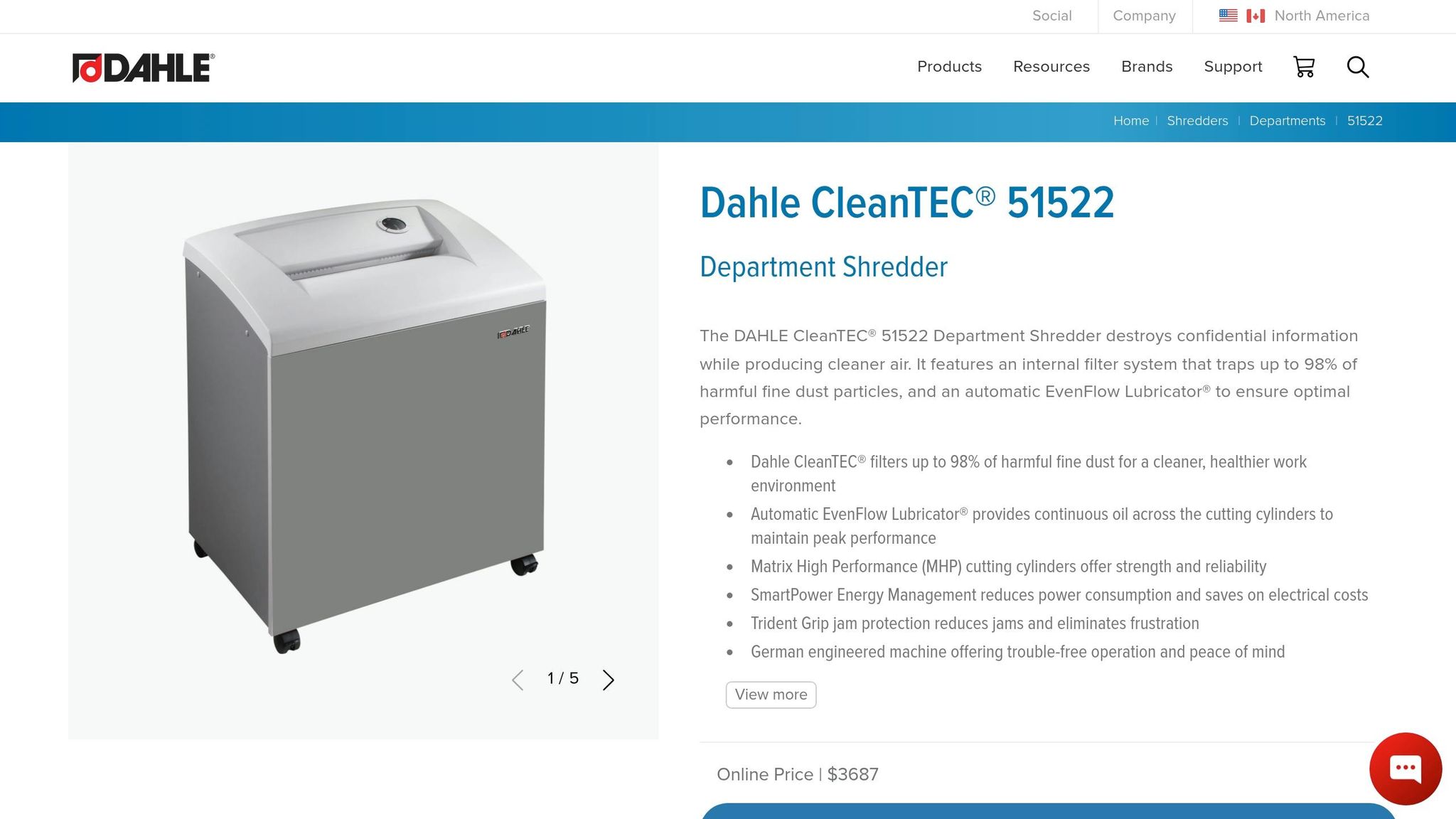
Dahle CleanTec 51522 Level P-5 Cross-Cut Department Shredder
sbb-itb-205d366
The Dangers of Improper Document Disposal
When sensitive documents aren't destroyed correctly, they pose serious risks to data security. Beyond financial and legal implications, the potential for physical reconstruction of improperly discarded documents creates an additional layer of vulnerability. This mishandling can lead to identity theft, data breaches, and hefty legal consequences.
Data Breaches and Identity Theft
Stealing someone's identity doesn't always require a single document. Criminals often use methods like "dumpster diving" to piece together information from discarded items, such as utility bills, bank statements, or medical forms, to create fraudulent profiles. The threat isn't limited to external actors - insider access can amplify the danger. A striking example is Morgan Stanley's $60 million fine in 2020 for failing to properly erase and dispose of sensitive data from decommissioned devices, exposing confidential client information.
The financial toll is staggering. In 2024, the average cost of a data breach in Canada climbed to $4.66 million. Canadians also lost millions in 2023 due to fraud and scams linked to stolen personal data. These statistics highlight the critical need for stringent data disposal practices to protect individuals and organizations.
Legal Consequences Under Canadian Privacy Laws
Canadian laws, such as PIPEDA, mandate proper disposal of personal information. The penalties for non-compliance are severe. Principle 5 of PIPEDA explicitly states:
"Personal information that is no longer required to fulfil the identified purposes should be destroyed, erased, or made anonymous."
Additionally, Paragraph 4.7.5 emphasizes the need for careful disposal to prevent unauthorized access. Simply tossing documents into recycling bins fails to meet these requirements. For instance, in a highly publicized case, paper medical records for up to 483,000 individuals were lost during transport, exposing patients to identity theft risks. Such incidents underline the importance of adhering to legal standards.
Document Reconstruction from Lower-Level Shredding
Improper shredding introduces another layer of risk. Many people mistakenly believe that any shredder is sufficient, but basic strip-cut shredders - often used in homes and small offices - produce long strips of paper that can be reconstructed with effort. Even tearing documents by hand offers little security.
Lower-security shredding methods (P-1 through P-4) leave documents susceptible to reconstruction. As noted by Papersavers Ltd:
"If you are still tossing unshredded papers into the trash or recycling, you are taking a serious and unnecessary risk."
The risk isn't confined to paper. Neglecting to properly destroy hard drives or erase encrypted data from electronic devices can also result in significant breaches. For complete security, physical destruction remains the only foolproof method.
DIN 66399 Security Levels Explained
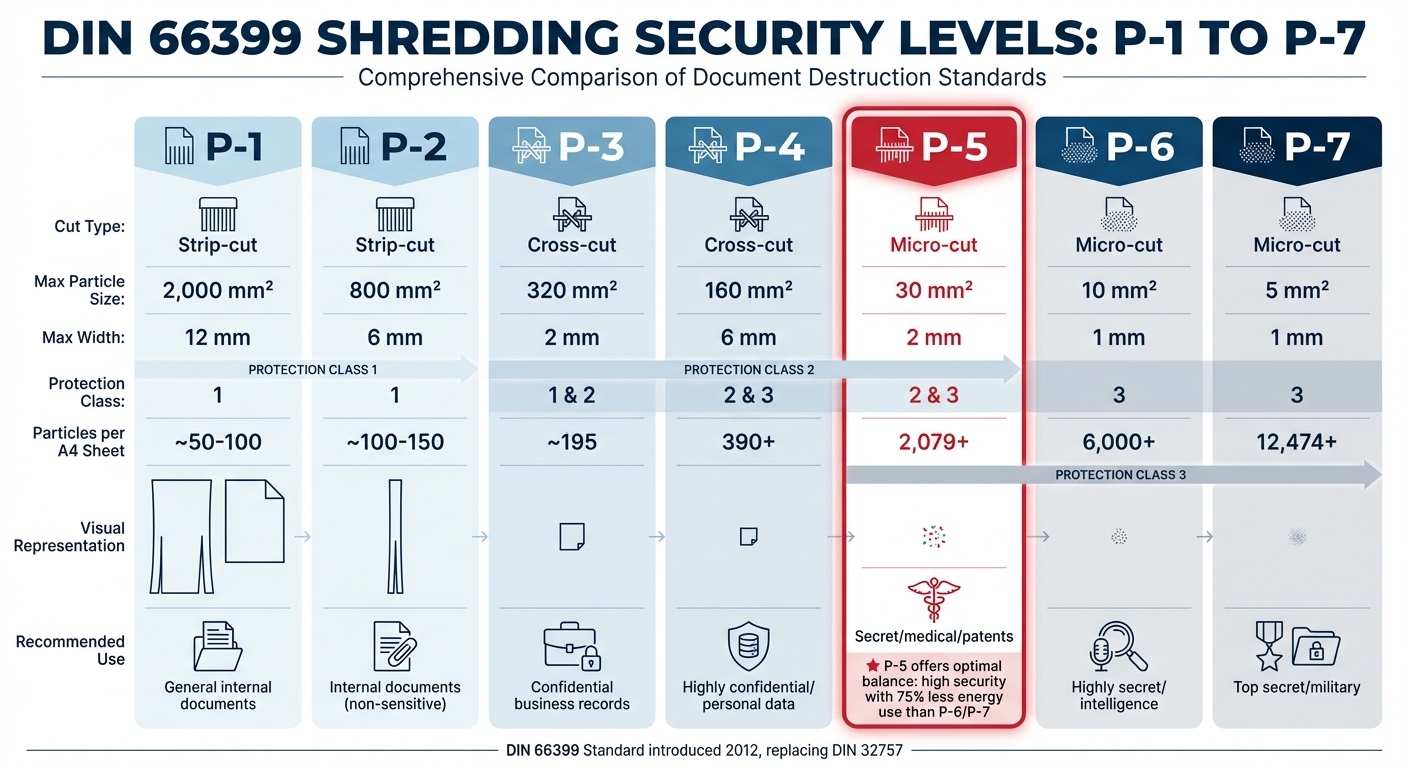
DIN 66399 Shredding Security Levels P-1 to P-7 Comparison Chart
DIN 66399 outlines seven distinct security levels for shredding documents and other materials. Introduced in 2012, this standard replaced the older DIN 32757 system, offering a more precise framework for document destruction. The seven levels (P-1 to P-7) apply to paper-based materials, with each level producing smaller particles, making reconstruction increasingly challenging.
These levels are grouped into three Protection Classes:
- Class 1: For basic internal data requiring normal protection.
- Class 2: For confidential information needing higher protection.
- Class 3: For secret data requiring the highest level of security.
The "P" designation applies specifically to paper. Other materials have different prefixes, like "H" for hard drives, "O" for optical media (e.g., CDs), and "E" for electronic media (e.g., USB drives).
Shredding Levels P-1 to P-7 Compared
The main difference between these levels lies in particle size and cut type. Lower levels (P-1 and P-2) use strip-cut shredders, which slice paper into long ribbons that are relatively easy to reassemble. Mid-range levels (P-3 and P-4) use cross-cut shredders, creating smaller rectangular particles by cutting in two directions. At the highest levels (P-5 to P-7), micro-cut shredders produce such tiny pieces that reconstruction becomes nearly impossible.
To illustrate, shredding a single A4 sheet at P-3 results in about 195 particles, while P-4 produces over 390 particles. By P-5, the same sheet is reduced to more than 2,079 particles, and at P-7, it’s shredded into approximately 12,474 particles.
| Security Level | Cut Type | Max Particle Size | Max Width | Protection Class | Recommended Use |
|---|---|---|---|---|---|
| P-1 | Strip-cut | 2,000 mm² | 12 mm | 1 | General internal documents |
| P-2 | Strip-cut | 800 mm² | 6 mm | 1 | Internal documents (non-sensitive) |
| P-3 | Cross-cut | 320 mm² | 2 mm | 1 & 2 | Confidential business records |
| P-4 | Cross-cut | 160 mm² | 6 mm | 2 & 3 | Highly confidential/personal data |
| P-5 | Micro-cut | 30 mm² | 2 mm | 2 & 3 | Secret/medical/patents |
| P-6 | Micro-cut | 10 mm² | 1 mm | 3 | Highly secret/intelligence |
| P-7 | Micro-cut | 5 mm² | 1 mm | 3 | Top secret/military |
This breakdown highlights why Level P-5 is a popular choice for those needing advanced security.
Level P-5: How It Works and When to Use It
Level P-5 strikes a balance between high security and practicality. It shreds documents into particles no larger than 30 mm² with a 2 mm width, making reconstruction nearly impossible. As Shredsec puts it:
"The higher the security level, the smaller the particle size and the more impossible reconstruction becomes."
Designed for "secret" or highly sensitive information, P-5 is ideal for materials that must remain confidential. Examples include medical records, patents, R&D documents, merger and acquisition files, and strategic financial data. Phil Taylor from The Shredder Warehouse explains:
"P-5 is defined as 'data media with confidential information of fundamental importance for a person, company or institution'."
For organizations handling intellectual property, legal documents, or data with life-or-death implications, P-5 offers a dependable solution. While higher levels like P-6 and P-7 provide even more security, they come with increased energy use and costs - up to 75% more. This makes P-5 a practical choice for most highly sensitive data, balancing security needs with resource efficiency.
Why Level P-5 Shredding Provides Maximum Data Security
Maximum Protection for Confidential Information
Level P-5 shredding reduces documents into particles smaller than 30 mm², with a maximum width of 2 mm. This extreme reduction turns documents into tiny, randomized fragments, leaving virtually no legible surface area for reconstruction. As Andy Sowards puts it:
"The tiny particles scattered randomly make reconstruction practically impossible, even with advanced technology and unlimited time."
Unlike strip-cut shredders that leave behind long, reassemblable strips, P-5's micro-cut process ensures that the data is completely destroyed. This level of security is critical for disposing of classified documents, sensitive corporate information like acquisition plans, or personal details such as Social Insurance Numbers and medical records. For organizations handling trade secrets, executive communications, or defence-related materials, P-5 shredding safeguards against even the most sophisticated reconstruction attempts.
By preventing advanced recovery methods, P-5 shredding also complies with Canadian privacy laws, providing a secure solution for managing sensitive information.
Meeting Canadian Privacy Law Requirements
Canadian privacy laws require that personal information be destroyed in a way that prevents reconstruction. Level P-5 shredding meets this standard by turning documents into irretrievable particles. According to PIPEDA Principle 5, personal information that is no longer needed for its original purpose must be destroyed, erased, or anonymized. P-5 shredding delivers the necessary security for highly sensitive data covered under these regulations.
The financial risks of non-compliance are steep. Under PIPEDA, organizations can face fines of up to $100,000 per violation. Ontario's PHIPA imposes even harsher penalties, with fines reaching $500,000 for organizations and $200,000 for individuals who fail to protect health information. Professional P-5 shredding services offer a Certificate of Destruction, providing legal proof of compliance during audits or reviews by the Privacy Commissioner of Canada. This certificate establishes a clear chain of custody, helping organizations avoid liability.
Nerds Need: Level P-5 Shredding Services
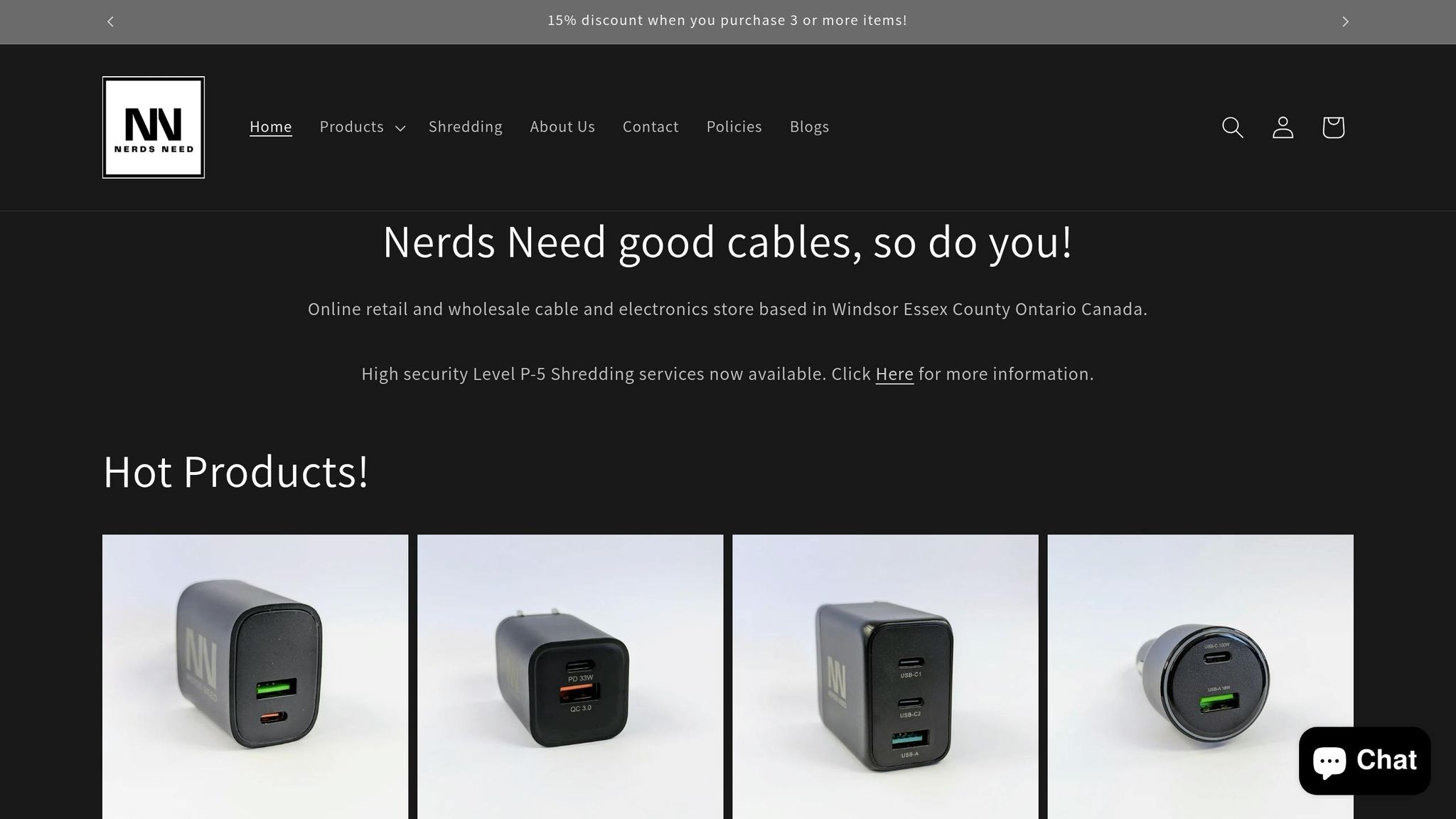
What Nerds Need Shredding Services Offer
Nerds Need provides high-security Level P-5 shredding, reducing documents into tiny particles no larger than 30 mm², with a maximum width of 2 mm. This micro-cut technology makes it nearly impossible to reassemble shredded documents. Unlike basic strip-cut shredders you might use at home, Nerds Need's P-5 shredding ensures complete destruction of sensitive information, such as Social Insurance Numbers and medical records.
Each shredding job comes with a Certificate of Destruction, which serves as legal proof that documents were securely disposed of, meeting Canadian privacy regulations. This certificate provides a clear chain of custody, crucial during Privacy Commissioner audits. From collection to final disposal, Nerds Need ensures secure handling of documents, complying with PIPEDA and Ontario's PHIPA. This not only protects sensitive data but also ensures businesses meet strict legal standards.
How Canadian Businesses and Consumers Benefit
This secure shredding process offers clear advantages for both businesses and consumers. Industries like tax offices, medical clinics, and law firms face strict rules for protecting client data. Nerds Need’s P-5 shredding securely destroys financial records, patient health information, and proprietary legal documents, making them irretrievable. Failing to properly dispose of personal data can result in fines of up to $100,000 under PIPEDA.
These risks highlight the importance of secure document disposal. Nerds Need mitigates such risks by using locked collection bins and following strict security protocols throughout the shredding process, ensuring full compliance with Canadian privacy laws.
In addition to paper shredding, Nerds Need also offers electronic media disposal, including hard drives, tablets, and cell phones. This comprehensive approach helps Canadian businesses not only meet their legal responsibilities but also maintain customer trust by safeguarding sensitive information.
How to Implement Level P-5 Shredding in Your Organization
Training Teams on Secure Shredding Procedures
A "shred-it-all" policy can simplify secure document disposal by ensuring that all unneeded paperwork is destroyed immediately. This eliminates confusion about what qualifies as sensitive and helps prevent accidental exposure. Pair this with a clean desk policy, which requires employees to secure all documents after use, to further reduce risks.
Training sessions should teach employees how to recognize Personally Identifiable Information (PII), financial records, and proprietary corporate data - like customer lists, payroll details, and contracts - that demand Level P-5 micro-cut shredding.
"Embedding these regulations so they are part of employee training and a standard workplace process will help strengthen a culture of security throughout the organization." - Shred-it
Use visual reminders like posters near printers and desks to reinforce these protocols. Regular walk-throughs of workspaces can spot any documents left unsecured. With the average cost of a data breach hitting nearly $4.9 million USD in 2024 - a sharp 11% increase from the previous year - investing in proper training is more than just a precaution; it’s a necessity.
Don’t overlook electronic media, which requires its own secure disposal process.
Combining Document Shredding with Electronics Disposal
Paper isn’t the only vulnerability. A 2015 study revealed that 48% of second-hand hard drives and smartphones still contained sensitive personal data. For digital media, physical destruction is the only surefire way to prevent data recovery. However, electronic devices should NEVER be placed in standard shredding bins due to the fire risks they pose.
Set up separate disposal streams for electronics. Each device - whether it’s a laptop, hard drive, or tablet - should be logged and tagged upon collection to create an accurate audit trail. Industrial shearing equipment, which applies 40,000 lbs of force, can obliterate hard drive platters, while crushing tools use about 7,500 lbs of force to render drives unusable. Don’t forget external media like SIM cards and memory cards; these should be removed and destroyed separately, as factory resets often fail to erase them completely.
For both paper and electronic assets, follow a documented chain of custody. Use locked bins for collection and GPS-tracked vehicles for transportation. Under PIPEDA, organizations are responsible for ensuring secure handling of sensitive information throughout the entire disposal process, even when outsourcing to third-party vendors.
Conducting Regular Compliance Audits
Maintaining Level P-5 shredding standards requires ongoing oversight. Regular audits ensure that shredding policies are followed and legal obligations are met.
Start by reviewing document retention schedules. For instance, tax records must be kept for six years, while health records require a ten-year retention period. Check data inventories periodically to confirm whether the original purpose for collecting the information has been met. If it has, initiate immediate disposal.
Always request a Certificate of Destruction for each disposal event. This certificate serves as legal proof of when and how the destruction occurred. Assign a dedicated team member to oversee these policies and ensure compliance across all staff. Additionally, revisit retention schedules regularly to avoid keeping data longer than required by law.
Conclusion
The risks of improper document disposal are too great to ignore, making Level P-5 shredding a must for safeguarding sensitive information. This advanced micro-cut technology destroys documents into particles so tiny that reconstruction is impossible, unlike traditional strip-cut methods. For Canadian organizations managing confidential data - like customer records or medical files - this level of security is essential.
Compliance with laws like PIPEDA and PHIPA requires proper destruction processes, often verified through Certificates of Destruction. Considering the steep fines of up to $100,000 per PIPEDA violation and the staggering $4.66 million average cost of a data breach in 2024, relying on basic shredders or recycling bins simply isn’t enough.
As industry experts emphasize:
"Physical destruction is the only 100% secure way to ensure data can't be retrieved or reconstructed." – Shred-it
Nerds Need offers a reliable solution by combining electronics expertise with high-security Level P-5 shredding. Their service ensures documents are securely handled from collection to destruction, with documented proof to meet compliance requirements.
Beyond protecting sensitive information, professional shredding also contributes to environmental efforts. In 2023 alone, a major shredding provider recycled 906 million pounds (around 411,000 tonnes) of paper globally. By choosing secure shredding, you not only protect your organization but also support sustainability initiatives.
FAQs
When should I choose P-5 shredding?
When you need to securely dispose of highly sensitive documents - like confidential financial records or legal papers - P-5 shredding is the way to go. This method creates micro-cut particles that are incredibly hard to piece back together, offering top-tier protection for your data.
What does a Certificate of Destruction prove?
A Certificate of Destruction is a formal document that verifies sensitive materials or documents have been securely and permanently destroyed. It acts as legal evidence of proper disposal, ensuring compliance with privacy laws and data protection standards. This certificate not only protects confidential information but also showcases a commitment to maintaining privacy regulations.
How should I securely dispose of old hard drives and phones?
To safely get rid of old hard drives and phones, physical destruction methods like shredding or crushing are the most reliable ways to ensure data is gone for good. DIY approaches can be risky, as they might leave traces of data that can still be recovered. Opting for professional services that provide Level P-5 shredding is a safer bet. These services guarantee thorough destruction and meet strict data security and compliance standards. Avoid recycling or donating devices without securely destroying the data first, as leftover information can be retrieved and potentially misused.